


You’re at a crossroads, and choosing the right loan matters more than you might expect. Perhaps your dream home is a sleek modern place in Silicon Valley or a stylish estate in Beverly Hills. Such a purchase could exceed the usual mortgage limits, which is why deciding between a jumbo and a conventional loan is important.
Here’s the reality: if your ideal property costs more than $806,500, which is the conforming limit in most areas, you’ll need to consider a jumbo loan. However, if your property is under that amount, a conventional loan could help you save money and reduce hassle. If you’re looking in places like San Francisco or Los Angeles, be aware that high-balance conforming loans, going up to $1,209,750, may still qualify as conventional.
What Makes a Conventional Loan (Including Those High-Balance Ones)?
Conventional loans are standard home loans that Fannie Mae or Freddie Mac buy and bundle into securities. These everyday loans often come with lower rates and flexible options.
Limits to know: In 2025, the baseline conforming limit is $806,500, with a high-cost ceiling of $1,209,750 in expensive counties.
As long as you stay under those limits, you’ll have more predictable terms.
Jumbo Loans: What Happens When You Cross That Line
If your loan exceeds that top limit, you’ve entered the jumbo territory:
You won’t be selling that mortgage to Fannie or Freddie. Lenders perceive more risk and require proof: a credit score above 700 —usually—, strong reserves, and a larger down payment.
Evaluate your financial profile before making decisions.
The “jumbo vs conventional loan” question is essential for your financial future.
Jumbo vs Conventional Loan: Updated Side-by-Side
Loan Amounts
Conventional Loan: Up to $806,500 in most of the U.S. and up to $1,209,750 in high-cost California counties like San Francisco, LA, and Orange County.
Jumbo Loan: Any amount above those limits. This could mean $1.3 million in LA or $3 million in Silicon Valley.
Credit Score Requirements
Conventional: Many lenders accept scores down to 620, but the best rates usually start at 740.
Jumbo: Generally, the minimum is around 700 to 720, with lenders preferring scores of 740 or higher for the best pricing.
Down Payment Expectations
Conventional: First-time buyers can get in for as little as 3 to 5% down, but expect PMI if you put down less than 20%.
Jumbo: The 20% down payment rule still applies, though some competitive lenders now offer 10 to 15% down for strong borrowers.
Interest Rates
Conventional: As of early 2025, rates for 30-year fixed conventional loans are around 6.5 to 6.75% for strong borrowers.
Jumbo: Rates have historically been higher, but the gap has narrowed. Some jumbo rates are now within 0.25% of conventional or even lower in highly competitive lending markets.
Debt-to-Income Ratio (DTI)
Conventional: Most lenders cap DTI at around 45%, although exceptions occur with strong compensating factors.
Jumbo: Typically expect a maximum DTI of 38 to 43%, with stricter scrutiny on variable income.
Cash Reserve Requirements
Conventional: Often, 2 to 3 months’ reserves are needed, but this is sometimes waived for strong profiles.
Jumbo: Usually requires 6 to 12 months’ reserves, especially for self-employed borrowers or luxury properties.
Pros & Cons
Conventional Loan Pros
✔ Lower down payment options
✔ Easier qualification for most buyers
✔ Often slightly lower rates than jumbo, although the gap is smaller now
✔ Flexible property types: primary, second home, investment
Conventional Loan Cons
✘ PMI if you put down less than 20%
✘ Limited loan size; not suitable for ultra-high-value properties
Jumbo Loan Pros
✔ Higher loan amounts for luxury or high-cost markets
✔ No PMI requirement, even below 20% down if the lender allows it
✔ Can sometimes get competitive rates if you have excellent credit
Jumbo Loan Cons
✘ Stricter credit, income, and reserve requirements
✘ Larger down payments for most situations
✘ More documentation is needed; expect a thorough review of your finances

Who Should Choose Which
A jumbo loan isn’t just for people looking for a mansion in Beverly Hills. It’s for anyone buying in a high-cost market where even a modest home exceeds the conforming limit.
Example: You’re house-hunting in San Mateo, CA, and find a $1.85M four-bedroom. The 2025 conforming limit there is $1,209,750. Unless you have nearly $650K in cash, you’re entering jumbo territory.
Jumbo is usually the right fit if:
✔ Your property price exceeds conforming limits in your county.
✔ You have a credit score of 700–740 or higher and stable income.
✔ You can cover 20% down, or at least 10–15% if your lender allows.
✔ You have 6–12 months’ reserves saved.
✔ You are willing to show all your finances in detail.
When a Conventional Loan is the Smarter Play
If your dream home is below the conforming cap in your county, conventional financing will almost always be easier and cheaper over the long term.
Example: You’re buying a $900K home in Riverside County (limit: $1,209,750). That means you can stay within the conforming guidelines, possibly put down 10% or less, and get a better rate with fewer requirements.
Conventional is usually best if:
✔ Your purchase price is within the conforming loan limits.
✔ You want a low down payment (3–5% for first-timers).
✔ You prefer more flexible DTI limits (up to around 45%).
✔ You’re okay with temporarily paying PMI if you don’t reach 20% down.
✔ You’re buying a primary residence, second home, or small investment property.
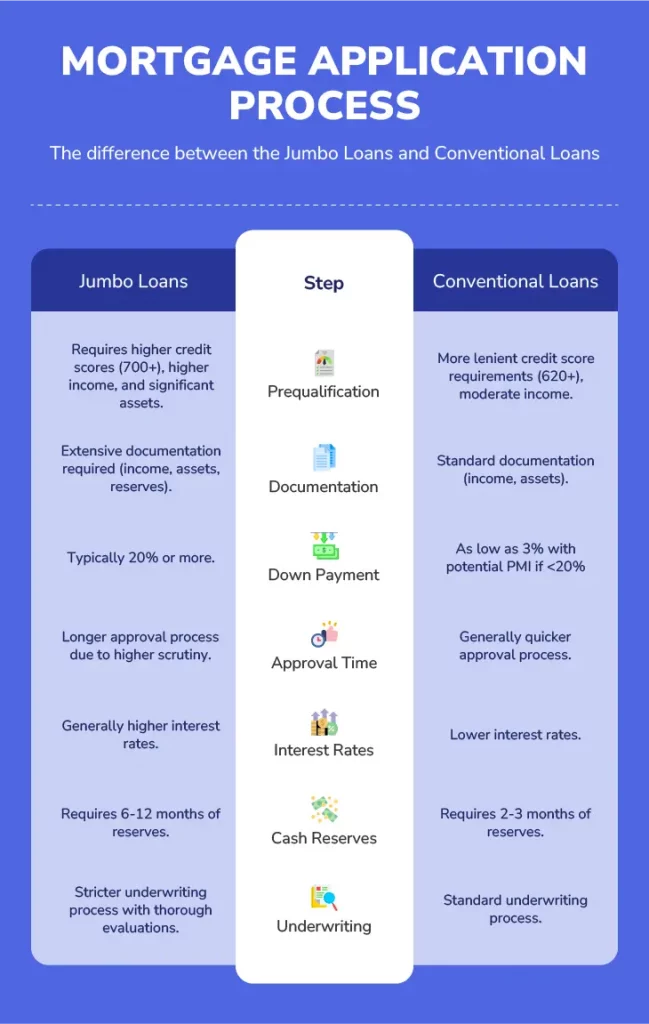
How the Application Process Differs
Jumbo Loan Application
Think of this as applying for VIP access; you get in if you meet the criteria, but they will check everything closely. Expect:
- Extra income documentation, especially for bonuses, commissions, or self-employment.
- Detailed asset verification, including brokerage accounts, retirement funds, and vesting schedules if you have stock grants.
- Stricter DTI thresholds; your side hustle income won’t always count unless you can prove it has been consistent for two or more years.
Conventional Loan Application
This is more like a standard check at the airport—still thorough, but faster and less intense. Expect:
Often quicker underwriting turnarounds.
Standard income, employment, and asset verification.
More forgiving rules on property types, such as condos, townhomes, and 2–4 unit properties.
The Bottom Line
The choice between a jumbo and a conventional loan comes down to one question:
Does your dream home’s price fit under your county’s conforming loan limit?
If yes: Conventional is your best option—lower barriers, more flexibility, and often better long-term affordability.
If no: Jumbo can open the door to properties that conventional loans cannot reach. Just be prepared for a stricter approval process.
Ready to Choose Between Jumbo and Conventional? Let’s Make It Simple.
Buying a home, whether it’s a chic $800K condo in Pasadena or a $2.5M hillside retreat in Marin, isn’t just about finding the right property. It’s about matching that property with the loan that keeps your finances strong and your stress levels low.
The truth is, you don’t have to figure it out alone. At Carlyle Financial, we’ve helped clients across California navigate the jumbo versus conventional loan decision with confidence. We match them to the right program, secure competitive rates, and ensure the process is as smooth as possible from pre-approval to closing day.
We’ll run the numbers for your specific property, break down the actual monthly cost of each option, and even point out potential pitfalls before you commit. This way, you’re never caught off guard by a detail in the fine print.
Whether you’re stretching beyond conforming limits or staying comfortably within them, our team knows how to tailor your mortgage strategy to suit both your dream home and your long-term financial goals.
Let’s talk. Contact Carlyle Financial today and take the guesswork out of choosing between jumbo and conventional. Because the right loan isn’t just about getting the keys; it’s about making sure you love the payment as much as you love the property.
Connect with our mortgage experts today so you can
be one step closer to your dream home!
Disclaimer: The information provided in this article is for educational and informational purposes only and should not be construed as financial, legal, or professional advice. All loan approvals are subject to borrower qualification, credit approval, and underwriting requirements. Loan terms, conditions, and policies vary by lender and current economic conditions. Carlyle Financial is a licensed mortgage broker by the California Department of Real Estate, and our services are subject to state regulatory oversight. Prospective borrowers are encouraged to consult with a qualified professional to understand better the best mortgage options for their specific circumstances. Rates and terms are subject to change based on market conditions and borrower eligibility.